Determining the correct load capacity is the most fundamental and critical step in the design of a 50-ton overhead crane. While “50 tons” may appear to be a fixed and straightforward number, in engineering practice it represents far more than the simple weight of a lifted object. Load capacity determination directly influences structural design, mechanical component selection, safety systems, cost, compliance with standards, and long-term operational reliability.
A poorly defined load capacity can lead to overdesigned systems with unnecessary costs, or worse, underdesigned cranes that pose serious safety risks. This article provides a comprehensive explanation of how load capacity is determined in the design of a 50 ton overhead crane, covering engineering principles, real-world operating conditions, safety factors, and applicable standards.
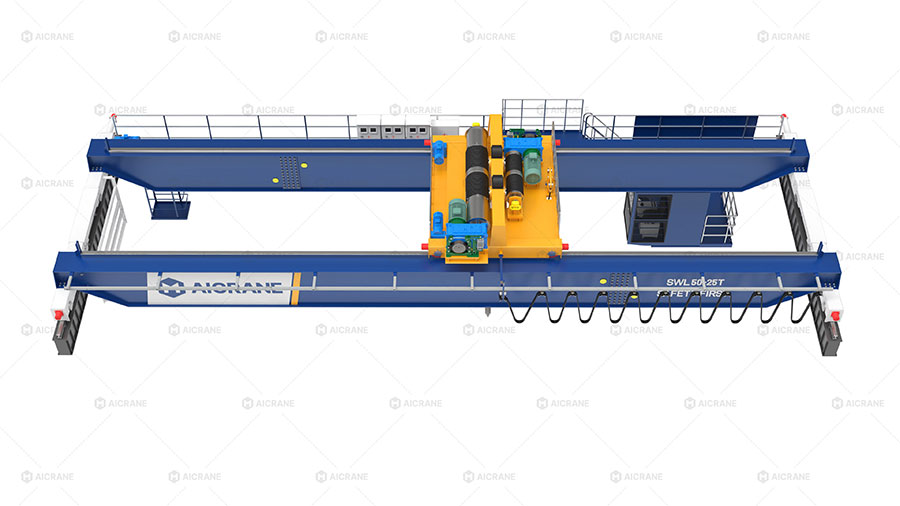
1. Understanding the Rated Load of a 50-Ton Overhead Crane
The rated load of a 50-ton overhead crane refers to the maximum allowable load that the crane is designed to lift under normal operating conditions, excluding the weight of the crane’s own lifting components.
In practical terms, the rated load includes:
-
The weight of the lifted object (payload)
-
Any below-the-hook lifting devices (e.g., hooks, spreader beams, C-hooks, magnets, grabs)
It does not include:
-
Hoist self-weight
-
Trolley weight
-
Bridge girder weight
These self-weights are accounted for separately in structural and wheel load calculations.
However, in many industrial applications, the actual working load may fluctuate. Therefore, determining the correct rated load requires a clear understanding of how the overhead traveling crane will be used throughout its lifecycle.
2. Identifying the Actual Working Load
The first step in load capacity determination is defining the maximum actual working load. This involves more than simply asking, “What is the heaviest item to be lifted?”
Key questions include:
-
What is the maximum weight of the heaviest component?
-
Are multiple items lifted simultaneously?
-
Are lifting attachments interchangeable?
-
Is load growth expected in the future?
For example, in a steel mill or power plant, a component weighing 46 tons may be lifted using a 4-ton spreader beam and hooks. In this case, the actual lifted load becomes 50 tons, leaving no margin for dynamic effects or future expansion. Engineers may therefore recommend a higher rated capacity (e.g., 55 or 63 tons) to ensure safety and flexibility.
3. Accounting for Dynamic Load Effects
Static load alone does not represent real crane operation. A 50-ton overhead crane is subject to dynamic loads caused by:
-
Acceleration and deceleration during lifting
-
Sudden starts and stops
-
Load sway
-
Impact during load pickup
-
Emergency braking
To account for these effects, design standards introduce a dynamic load factor (DLF), sometimes called an impact factor. Depending on the duty class and lifting speed, this factor typically ranges from 1.1 to 1.4.
For example:
-
Static load: 50 tons
-
Dynamic factor: 1.25
-
Equivalent design load: 62.5 tons
This equivalent load is used in the design of:
-
Girders
-
Hoisting mechanisms
-
Wire ropes
-
Drums
-
Bearings
-
End trucks
Ignoring dynamic effects can significantly underestimate the true forces acting on the crane.
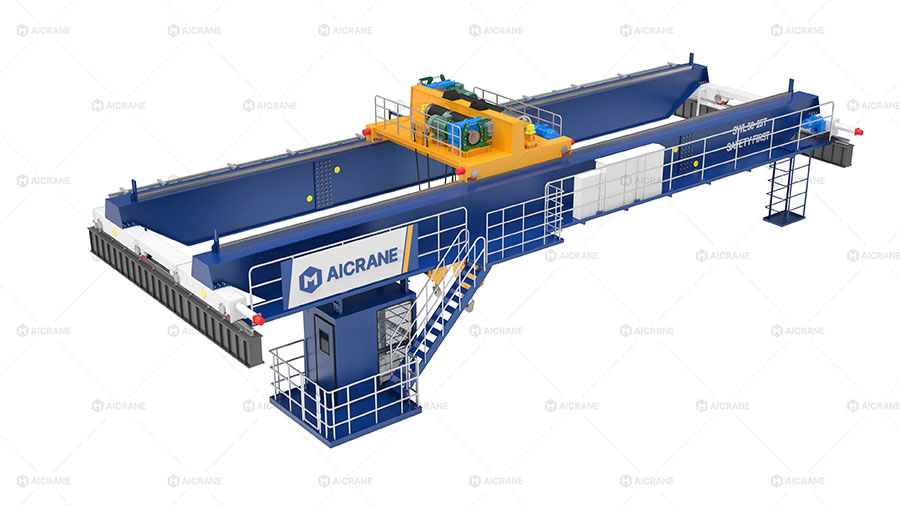
4. Influence of Crane Duty Class on Load Capacity Design
A 50-ton overhead crane for sale used occasionally for maintenance is very different from one operating continuously in a steel plant. This is why duty classification plays a central role in load capacity determination.
Common standards include:
-
FEM (Europe)
-
ISO
-
CMAA (North America)
-
GB (China)
Duty class defines:
-
Load spectrum (percentage of full load lifts)
-
Number of working cycles
-
Service life expectations
For example:
-
A FEM A5 / ISO M5 crane may handle frequent medium loads
-
A FEM A7 / ISO M7 crane may handle frequent near-rated loads in harsh environments
Although both may be rated at 50 tons, the higher duty crane will require:
-
Larger safety margins
-
Stronger structural members
-
Higher-grade mechanical components
Thus, load capacity determination must be aligned with how often and how intensely the crane will operate.
5. Structural Design Implications of a 50-Ton Rated Load
Once the design load is established, it directly affects the structural design of the crane bridge.
Key considerations include:
-
Girder type (single vs double girder)
-
Girder height and plate thickness
-
Allowable deflection limits
-
Fatigue resistance
For a 50-ton overhead crane, a double girder crane configuration is almost always selected because it offers:
-
Higher load-bearing capacity
-
Better stiffness
-
Reduced deflection
-
Greater lifting height
Typical deflection limits (e.g., L/700 or L/800) are applied using the design load, not just the rated load. Excessive deflection can lead to misalignment, rail wear, and long-term fatigue damage.
6. Hoist and Lifting Mechanism Capacity Selection
The hoist is the heart of the crane, and its capacity must be carefully matched to the determined load.
Hoist design considerations include:
-
Rated hoist capacity (≥ 50 tons)
-
Motor power
-
Gearbox strength
-
Brake torque
-
Drum diameter and length
-
Wire rope safety factor
Standards typically require wire rope safety factors of 5:1 or higher for heavy-duty cranes. This means that even if the crane is rated for 50 tons, the wire rope breaking strength must be significantly higher.
Additionally, the hoist must be capable of handling overload scenarios, such as test loads (often 125% of rated capacity).
7. Wheel Loads and Runway Design Considerations
Load capacity determination also affects wheel load calculations, which are critical for:
-
Crane rails
-
Runway beams
-
Building structure
A 50-ton crane imposes concentrated loads that vary depending on:
-
Trolley position
-
Load distribution
-
Span length
-
Crane self-weight
Incorrect load assumptions can result in:
-
Rail deformation
-
Excessive building stress
-
Premature structural failure
Therefore, accurate determination of crane load capacity is essential not only for the crane itself but also for the supporting infrastructure.
8. Safety Margins and Overload Protection
Safety is a non-negotiable aspect of load capacity determination. Modern 50-ton overhead cranes are equipped with:
-
Overload limiters
-
Load cells
-
Emergency stop systems
-
Redundant braking systems
These systems are calibrated based on the rated load, not the maximum theoretical load. A clear and conservative load capacity definition ensures that protective systems function correctly and consistently.
9. Future Expansion and Operational Flexibility
Many industrial users underestimate future requirements. A crane designed strictly for a 50-ton load today may become insufficient tomorrow.
Designers often consider:
-
Potential load increases
-
Additional lifting attachments
-
Process upgrades
In some cases, designing structural components with reserve capacity while limiting the rated load through control systems can provide a cost-effective balance between safety and flexibility.
10. Conclusion
Load capacity determination in 50-ton overhead crane design is a multi-dimensional engineering process, not a single numerical decision. It integrates static and dynamic loads, duty classification, safety factors, structural behavior, mechanical design, and real-world operational demands.
A well-determined load capacity ensures:
-
Safe and reliable lifting operations
-
Compliance with international standards
-
Optimized structural and mechanical design
-
Long service life with minimal downtime
For heavy-duty industrial applications, investing time and expertise in accurate load capacity determination is not just good engineering practice—it is essential for operational success and long-term safety.